
this is not a root of a tree. but a root of a number.
i- is what you call an imaginary number.
-it is the square root of -1 [fascinates me alot]
i cube = - square root of -1 [same same]
so let me tell you a story about the radicals:
Roots and Radicals deserve their own chapter and homework because they occur frequently in applications.
Let  geq 2 $" align="middle" border="0" height="39" width="57"> be a natural number, and let
  be a real number. The
  -th root of is a number
  that satisfies
  The number is denoted by
 displaystyle b = \root n \of a. $" align="middle" border="0" height="48" width="81">
 For example,  since
since  , and
, and  since
since  .
.
The symbol  sqrt{\phantom{yz}} $" align="middle" border="0" height="42" width="45"> is called the radical symbol, and an expression involving it is called a radical (expression).
If  then is the square root of and the number
  is usually omitted. For example,
 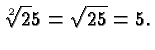 sqrt{25} = 5. $" align="middle" border="0" height="50" width="155">
If  , then is the cube root of . For example, the cube root of
  is
is  , and that of
  is .
is .
If is even and is positive then there are two -th roots of , each being the negative of the other. For example, since 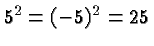 there are two square roots of
  . In that case by convention the symbol
  means the positive -th root of , and it is called the principal (-th) root of .
If is negative and is odd then there is just one -th root, and it is negative also. For example, 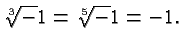
At this stage we do not know of an -th root if is even and is negative. This leads to the subject of complex numbers which we will take up later in the course.
Radicals are just special cases of powers, and you can simplify much of your thinking by keeping this fact in mind:

It follows immediately from that observation and the properties of powers that
 >
>
Solving Radical Equations
An equation involving radicals is called a radical equation (naturally). To solve it you simply apply our general principle:
To solve an equation figure out what bothers you and then do the same thing on both sides of the equation to get rid of it.
To get rid of a radical you take it to a power that will change the rational exponent to a natural number. This will work if the radical is on one side of the equation by itself.
Hope you enjoyed the story about the radicals and roots. because you will never get the answer if you will not try to analyze it. numbers might be scary on the outside but meaningful on the inside.


No comments:
Post a Comment